Climate-Resilient Employability: Integrating Green Skills into Youth Adaptation Pathways
Author:
Suhana Dogra
Independent Researcher, Former M.A. Student, Department of Geography, University of Jammu, Jammu & Kashmir, India
ORCID ID: 0009-0002-4875-7929
Email: dograsuhana25@gmail.com
Abstract/ Climate risks are reshaping labour markets, education systems, and development trajectories across the Global South, yet the role of human capital particularly youth skills and employability remain marginal in adaptation policy. While green-transition research highlights the need for low-carbon competencies, it rarely considers how skill ecosystems contribute to climate resilience. Adaptation scholarship, conversely, foregrounds ecological and infrastructural vulnerabilities but overlooks the labour, capability, and agency dimensions of resilience. This paper bridges these gaps by advancing adaptive employability as an integrative framework linking green-skills development, youth agency, and climate-resilient development.
Grounded in the Capability Approach and social-ecological resilience theory, the study conceptualises green skills as adaptive capabilities that expand young people's livelihood options, decision-making capacity, and contributions to community resilience. Drawing on a qualitative integrative review of 68 sources across South Asia, Sub-Saharan Africa, Southeast Asia, and Latin America, the paper synthesises evidence on emerging green-skills ecosystems, institutional barriers, and cross-regional innovations.
Findings reveal systemic fragmentation across education, labour, and climate-governance systems; persistent gendered and socio-economic inequities; and limited alignment between adaptation priorities and employability frameworks. At the same time, multi-level governance platforms, hybrid learning models, youth-led green entrepreneurship, and data-driven forecasting illustrate promising pathways through which skills development can strengthen adaptive capacity.
The paper provides actionable policy guidance for embedding adaptive employability within national adaptation strategies, aligning human-capital systems with climate policy, and ensuring inclusive, gender-responsive pathways toward climate-resilient development.
Keywords:/ Climate adaptation; Green skills; Youth employability; Adaptive capacity; Resilience pathways; Sustainable development policy
1. Introduction
Escalating climate risks are reshaping development trajectories across low- and middle-income countries, exposing deep structural vulnerabilities in labour markets, education systems, and governance institutions. While national adaptation plans continue to prioritise physical infrastructures, their effectiveness ultimately depends on the adaptive capacity of people---particularly youth, who comprise the largest share of the population in climate-vulnerable regions and who face disproportionately high unemployment and informality. Yet, despite this demographic centrality, the labour dimensions of climate adaptation remain conceptually thin and policy-marginal. The dominant discourse treats green skills as a narrow technical agenda linked to green jobs, rather than as a foundational component of adaptive human capital.
Existing research on green transitions provides valuable insights into employment potential, but it rarely connects skill formation to climate-resilience strategies, and even less to the lived conditions of young people navigating precarious labour markets (ILO, 2023; OECD, 2022). Adaptation scholarship, conversely, foregrounds ecosystem vulnerability, infrastructure, and governance but pays minimal attention to the skill ecosystems required to operationalise adaptation on the ground. This bifurcation has produced a structural blind spot: the absence of an integrated account of how green skills shape, and are shaped by, adaptation processes. The lack of theoretical and empirical synthesis prevents policymakers from understanding how labour markets can contribute to climate resilience or why many youth remain excluded from emerging green opportunities.
This paper addresses this gap by advancing adaptive employability as an integrative framework that links green skill development, livelihood transitions, and adaptation governance. Drawing on the capabilities approach (Sen, 1999; Nussbaum, 2011) and climate-resilient development pathways (IPCC, 2022), the paper conceptualises green skills not merely as sectoral competencies but as adaptive capabilities that expand the freedom, agency, and resilience of young people in a changing climate. This lens positions youth not as passive beneficiaries of adaptation policy but as active co-producers of resilience in households, communities, and local economies. In doing so, the study reframes adaptation as a human-capital process and not only a technological or infrastructural endeavour.
To substantiate this argument, the paper compiles and codes recent cross-country datasets on youth employment structures, climate-exposure profiles, and green-skills training initiatives (ILOSTAT, 2023; UNEP, 2022; UNESCO, 2023). Rather than providing descriptive mapping, the analysis identifies converging patterns that illuminate where green-skills ecosystems are emerging, where they remain fragmented, and how these patterns shape adaptive capacity across different institutional contexts. This produces new empirical insight into the distributional and justice dimensions of green skills an area notably absent in existing literature.
Together, these contributions establish the relevance and originality of the study. The paper offers:/ (1) a conceptual integration of adaptation, labour markets, and capability theory;/ (2) empirical evidence illustrating systemic gaps in green-skills ecosystems; and/ (3) a policy-oriented interpretation of youth as agents of climate resilience.
By foregrounding human capital as a core pillar of adaptation, the paper provides a pathway for aligning climate policy, skills development, and social equity an alignment urgently needed but rarely articulated in current scholarship.
2. Conceptual Framework and Methodological Approach
2.1 Theoretical Context: Green Skills, Youth Employability, and Climate Adaptation
This study is grounded in the intersecting literatures on green economic transitions, youth skills and employability, and climate adaptation governance. Although each field has expanded significantly, the connections between them particularly the role of skill ecosystems in shaping adaptive capacity remain loosely articulated.
Research on green transitions emphasises workforce readiness as a foundational element of low-carbon, resource-efficient development (UNEP, 2011; Bowen & Kuralbayeva, 2015). Simultaneously, scholarship on youth employability continues to document persistent structural mismatches between education systems and labour-market demands, mediated by gendered, spatial, and socio-economic inequalities (ILO, 2022; McGrath & Powell, 2016). These constraints intensify in climate-vulnerable contexts, where young people face heightened livelihood risk, exposure to climate hazards, and barriers to upward mobility (Cedefop, 2023; World Bank, 2022).
During the past decade, frameworks such as UNESCO's Greening TVET have broadened the conceptualisation of green skills to include technical abilities, anticipatory learning, systems thinking, and socio-emotional competencies essential for navigating complex socio-ecological change (UNESCO-UNEVOC, 2022). Yet these frameworks still predominantly orient green skills toward mitigation and green growth. Their potential significance for climate adaptation---particularly for young people whose futures will be shaped by instability, uncertainty, and environmental stress has been less systematically explored.
At the same time, climate adaptation research underscores the importance of human capabilities, learning processes, inclusive governance, and social infrastructure in enabling societies to adjust to climate pressures (IPCC, 2022; Folke et al., 2016). These insights point to an important but underexamined question: how skills, agency, and employability shape the adaptive possibilities available to young people and the communities they inhabit. This study engages directly with this question by positioning skill formation not merely as a labour-market concern but as a mechanism that influences the distribution of adaptive opportunities and constraints across different social groups.
2.2 Adaptive Employability: Skills, Agency, and Resilience
The analysis employs the concept of adaptive employability, which recognises that youth navigate labour markets that are increasingly shaped by climate impacts, environmental regulation, technological change, and socio-economic instability. In such conditions, employability involves more than accessing jobs; it hinges on the ability to learn, re-skill, and contribute to collective responses to climate-related risks.
The approach draws on two complementary perspectives. The Capability Approach (Sen, 1999; Nussbaum, 2011) emphasises the expansion of substantive freedoms, situating employability in relation to agency, opportunity, and the conditions that enable young people to build meaningful lives. This orientation helps illuminate how structural inequalities across gender, caste, class, and geography shape the distribution of skills and adaptive capacity.
The second perspective, social-ecological resilience theory (Folke et al., 2016; Pelling, 2011), highlights learning, flexibility, and innovation as essential features of systems undergoing environmental stress. From this standpoint, skills that enhance problem-solving, collaboration, and adaptive decision-making become integral to resilience, not peripheral to it.
Combining these perspectives allows adaptive employability to be understood as both an individual capability and a collective resource. Green skills can expand livelihood options, but they can also strengthen community participation, knowledge-sharing, and the ability to anticipate and respond to climate impacts. In this sense, youth skill development contributes to broader socio-ecological resilience by shaping how adaptation practices emerge and who benefits from them. The overall structure of these interactions is depicted in Figure 1, which consolidates the main elements of the adaptive employability framework.
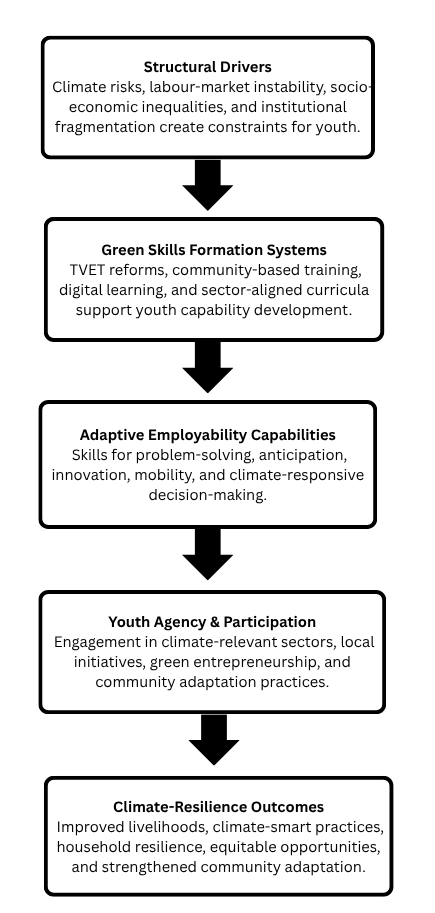
Figure 1. Conceptual framework illustrating how structural drivers, green-skills formation systems, adaptive employability capabilities, youth agency, and climate-resilience outcomes interact to shape youth adaptive capacity in climate-vulnerable contexts.
2.3 Analytical Scope and Methodology
A qualitative integrative review methodology was used to synthesise evidence across labour studies, green transition research, education policy, and climate adaptation literature. This approach is suited to topics where conceptual development is needed across multiple disciplines and where empirical insights are dispersed across diverse contexts.
Search Strategy and Inclusion Criteria
Searches were conducted across Scopus, Web of Science, Google Scholar, and institutional repositories (UN, ILO, UNESCO, ADB, World Bank). Keyword clusters included:/ "green skills," "youth employability," "TVET," "climate adaptation," "resilience," "just transitions," "workforce development."
Sources were included if they:/ a. examined youth skills, employability, or workforce development in climate-vulnerable or transitioning economies;/ b. linked labour, education, and environmental or climate governance; or/ c. provided empirical insights through programmes, national frameworks, or case studies.
Approximately 120 documents were screened, with 68 meeting the inclusion criteria.
Data Organisation
Selected sources were organised into three thematic domains:
-
Institutional and Governance Frameworks/ (national strategies, adaptation plans, TVET reforms, labour--environment policy linkages);
-
Education and Training Models/ (competency-based curricula, blended learning, informal and community-based training);
-
Socio-Economic, Equity, and Environmental Outcomes/ (employment transitions, livelihood security, gendered and spatial inequalities, adaptation co-benefits).
Analytical Procedure
A comparative thematic synthesis was conducted across regional contexts including South Asia, Sub-Saharan Africa, Southeast Asia, and Latin America to identify patterns of convergence, divergence, and emerging innovations. Coding focused on:
-
how green skills are conceptualised and applied in practice;
-
institutional coordination and governance arrangements;
-
relationships between skill ecosystems and adaptive capacity;
-
barriers and inequities shaping youth participation and outcomes.
This structure ensures conceptual clarity while grounding the analysis in diverse empirical trajectories.
2.4 Contribution of the Analytical Approach
By bringing together insights from green transitions, youth employability, and adaptation governance, the analytical approach clarifies how skills and agency shape the conditions under which young people respond to climate risks. It also highlights the institutional and structural factors that mediate the distribution of adaptive opportunities, offering an integrated perspective for aligning education, labour, and climate policy.
3. Analysis and Discussion
3.1 Dynamics of Green Skills and Youth Employability
Green-skills development is advancing in climate-vulnerable contexts, yet institutional and social unevenness persists. National strategies increasingly recognise green training as a lever for economic diversification, but translating policy commitments into coherent employability pathways remains challenging.
In South Asia, initiatives such as India's Skill Council for Green Jobs and Bangladesh's climate-resilient livelihood programmes have expanded training opportunities in solar installation, energy efficiency, and climate-smart agriculture (MSDE, 2023; ADB, 2024). Rural and informal youth who are disproportionately exposed to climate hazards---remain underserved. Participation gaps are pronounced: women constitute only 22--25% of cohorts in major renewable-energy programmes, highlighting entrenched gender barriers (ILO, 2023).
Sub-Saharan Africa shows strong political commitment but faces high labour-market informality and limited financing. Strategies in Kenya, Rwanda, and Ghana embed green skills within entrepreneurship and digital innovation ecosystems, yet apprenticeship systems, certification pathways, and market linkages remain fragmented (World Bank, 2023). Evidence indicates that youth-led adaptive employability initiatives enhance household resilience, improving income stability, promoting climate-smart practices, and facilitating community knowledge-sharing (UNDP, 2023--2024).
In Latin America, curriculum integration is higher, exemplified by Chile's Escuelas Verdes and Colombia's National Environmental Training Plan (OECD, 2023). Nevertheless, labour-market volatility in nature-based and circular-economy sectors limits predictable pathways from training to adaptive livelihoods.
Across regions, a common pattern emerges: supply-driven skill creation often lacks integration with resilience-oriented employment systems, constraining youth capacity to convert green competencies into meaningful adaptive actions. Addressing this gap is essential for global adaptation strategies.
3.2 Systemic Barriers to Adaptive Employability
Three interrelated constraints impede the integration of green skills into climate adaptation pathways: institutional fragmentation, pedagogical mismatch, and structural inequities.
(a) Institutional Fragmentation/ Governance remains siloed across ministries of labour, education, environment, and planning. Reviews of 29 developing economies indicate weak cross-sectoral coordination, producing programmes misaligned with labour-market and adaptation objectives (World Bank, 2023; UNEP, 2024). Fragmentation produces duplicated efforts, underfunded climate-skill components, and limited mechanisms for monitoring and accountability.
(b) Pedagogical and Curricular Inertia/ Core green competencies systems thinking, circular-economy literacy, socio-ecological problem-solving rarely appear in TVET or higher education curricula (UNESCO, 2023). Sustainability is often treated as a peripheral module, yielding skills adequate for narrow "green jobs" but insufficient for adaptive decision-making or household and community resilience-building.
(c) Economic and Social Inequities/ High informality constrains access to certification, stable employment, and career progression, with 75--85% of youth in South Asia and Sub-Saharan Africa employed in informal sectors (ILO, 2023). Gendered, socio-economic, and spatial inequities further restrict access to higher-value climate-relevant sectors. Young women face mobility restrictions, care responsibilities, and workplace discrimination (UN Women, 2023).
Together, these constraints demonstrate why conventional green-skills frameworks fail to enhance systemic resilience. Framing employability as an adaptive, capability-expanding process allows youth to contribute to household and community adaptive strategies while addressing structural inequities.
3.3 Emerging Pathways Linking Skills to Adaptation
Despite systemic challenges, several pathways demonstrate how green skills can enhance both employment and climate-resilience outcomes:
-
Integrated Multi-Level Governance Platforms/ Coordinating macroeconomic planning, skill development, and climate governance---as seen in PAGE and Africa's Continental Green Skills Programme---enables curriculum refinement, labour-market alignment, and cross-ministerial accountability (UNEP & ILO, 2024).
-
Community-Embedded and Hybrid Learning Models/ Localized training ecosystems combining digital learning with mentorship strengthen adaptive outcomes. The Barefoot Solar Engineering programme links renewable-energy skills with household energy security, water conservation, and climate-risk awareness, directly supporting household and community resilience (Barefoot College, 2023).
-
Green Entrepreneurship as an Adaptation Interface/ Youth-led ventures in regenerative agriculture, circular design, and micro-renewables generate high adaptive returns when integrating local knowledge and climate-risk assessments (UNDP, 2023--2024). These initiatives enhance livelihoods, improve household resilience, and catalyse broader community-level adaptive practices.
-
Data-Driven Skill Forecasting/ Emerging observatories in Brazil, South Africa, and Indonesia anticipate climate-sensitive employment trends, enabling governments to integrate adaptation into sector-specific skill pipelines and inform evidence-based policy and programme planning (OECD, 2024).
These innovations underscore the importance of integration, localisation, and data-informed planning for transforming green skills into effective adaptive employability systems. Operational examples of these dynamics across countries are outlined in Table 1, demonstrating how green-skills ecosystems contribute to adaptive employability in practice.
Initiative Country / Target Group Key Green Skills Adaptive / Region Focus Employment Outcomes
TVET for Green Brazil TVET and Renewable energy, Aligns vocational Economic Development higher-education circular economy, training with (GIZ) youth bioeconomy, green green-economy labour digital skills demand; improves employability in climate-relevant sectors.
IYF Green Skills Mexico TVET and Solar PV, energy Builds technical Programme university youth efficiency, green competencies; circular economy, trains instructors; technical English expands access to clean-energy jobs.
Empowering Colombia Rural and Renewable energy, Strengthens local Communities with (Amazon Indigenous youth sustainable green livelihoods; Green Skills (IDB + region) tourism, community supports SENA) resilience skills climate-adaptive income diversification.
Greening TVET in Multiple TVET students Sustainability Integrates Latin America Latin principles, sustainability and (UNESCO--UNEVOC) American resource green competencies countries efficiency, green into national TVET job readiness curricula; enhances youth transition into green labour markets.
Climate Skills Brazil, Youth aged 18--30 Climate Builds youth Youth Programme Mexico leadership, leadership and (British Council) adaptation adaptive capacity; literacy, green supports entrepreneurship climate-resilient start-ups and community initiatives.
Table 1. Global initiatives illustrating how green skills development and adaptive employability strategies are being operationalised across diverse socio-economic and ecological contexts. The table highlights programme objectives, target groups, implementation mechanisms, and documented resilience outcomes.
4. Policy Implications and Recommendations
4.1 Repositioning Green Skills as Core Adaptation Instruments
Climate policy frameworks often treat green jobs narrowly as sector-specific employment interventions, overlooking their potential as foundational elements of adaptive capacity. In climate-vulnerable countries, this framing is increasingly insufficient. National Adaptation Plans (NAPs) and Long-Term Low-Emission Development Strategies (LT-LEDS) should integrate green skills as cross-sectoral instruments, linking human-capital development to agriculture, urban planning, renewable energy, and public infrastructure (UNDP, 2024; UNEP, 2023).
Embedding skill development within climate policy aligns workforce capabilities with scaling renewable energy, climate-smart agriculture, and resilient infrastructure. This approach mitigates delays arising from technical skill gaps in rapidly expanding sectors such as decentralized solar, sustainable construction, and ecosystem-based adaptation.
An innovative mechanism is the introduction of Green Skills Impact Assessments (GSIAs) alongside conventional Environmental Impact Assessments (EIAs). GSIAs evaluate whether large-scale projects generate measurable skill transfers, employment opportunities, and local adaptive benefits (OECD, 2024). By shifting the focus from compliance to capability creation, GSIAs ensure that investments in climate action contribute directly to adaptive human capital, fostering social and economic co-benefits.
4.2 Strengthening Institutional Coordination and Multi-Level Governance
Institutional fragmentation across ministries of labour, education, environment, and finance continues to limit the effectiveness of green-skills strategies (World Bank, 2024). Establishing National Green Skills Councils with statutory inter-ministerial authority can harmonise standards, consolidate resources, and coordinate implementation. South Africa and Indonesia provide emerging models of such cross-sectoral governance.
Decentralised governance mechanisms enhance contextual relevance and local ownership. In Kenya, County Climate Change Funds channel devolved financing into community-level initiatives, including climate-smart agriculture training and youth-led micro-renewable projects (World Bank, 2023).
International cooperation and South--South knowledge exchanges further strengthen these efforts. Collaboration between Brazil, India, and South Africa on TVET reform has enabled curriculum transfer, monitoring frameworks, and cost-effective implementation (ILO, 2023), demonstrating how global learning networks can accelerate the operationalisation of adaptive employability.
4.3 Embedding Green Skills Across Education Systems
Education is the structural backbone of adaptive employability. Currently, climate literacy and sustainability remain peripheral in curricula. Long-term transformation requires integrating climate awareness, circular-economy principles, systems thinking, and digital-environmental competencies across primary, secondary, and tertiary education (UNESCO, 2023).
For TVET systems, a shift from short-course certifications to competency-based, interdisciplinary programmes is essential. Modular curricula that combine renewable-energy engineering with digital skills, entrepreneurship, and socio-environmental problem-solving equip youth not only for employment but for adaptive decision-making in climate-sensitive contexts (ADB, 2024).
Digital learning ecosystems expand access for rural and climate-exposed populations. Micro-credentialing platforms, particularly with internationally benchmarked certifications, reduce barriers of geography and cost while strengthening adaptive skill portfolios. When integrated into national qualifications frameworks, these platforms can mitigate inequalities in access to knowledge and opportunity (OECD, 2024).
4.4 Financing Mechanisms for Youth-Led Green Transitions
Sustaining adaptive employability requires predictable, diversified financing. Many youth-focused adaptation initiatives remain dependent on time-bound donor projects, creating discontinuity in skill development and enterprise support. Blended finance instruments including green bonds, impact investment funds, concessional credit lines, and public--private partnerships offer more durable solutions (UNEP, 2023).
Institutionalising Youth Green Enterprise Funds can provide low-interest loans, technical assistance, and incubation support for ventures in renewable energy, nature-based solutions, and sustainable value chains. Evidence from UNDP's 2023--2024 Greenpreneurs Programme indicates that targeted financial and mentorship support improves both business survival and local resilience outcomes.
Fiscal incentives for firms hiring certified green-skilled youth create sustainable demand for adaptive competencies. Such measures catalyse private-sector participation in sectors critical to ecological transitions, including regenerative agriculture, eco-restoration, and repair-and-reuse industries, while promoting broader social and economic inclusion.
4.5 Social Inclusion, Gender Equity, and Justice
Green transitions risk perpetuating social inequalities unless inclusion is deliberately embedded. Women are underrepresented in renewable energy, waste management, and circular-economy sectors due to mobility, safety, and social constraints (UN Women, 2023). Marginalised youth---including rural, tribal, migrant, and informal-sector populations---face additional barriers.
Policy interventions include:
-
Gender-Responsive Green Skills Strategies providing childcare, mobility support, and safe training infrastructure.
-
Recognition of Prior Learning (RPL) Schemes formalising informal competencies and enabling transitions into certified green employment.
-
Community-Based Apprenticeships rooted in local adaptation priorities, linking skill development with household and community resilience. Evidence shows these models strengthen local adaptive capacity by improving knowledge-sharing, fostering climate-smart practices at the household level, and supporting equitable economic participation (Global Center on Adaptation, 2024; weADAPT, 2023).
These approaches demonstrate that adaptive employability can advance climate action, social equity, and resilience simultaneously, while ensuring that the benefits of green skills are widely distributed across vulnerable populations globally.
4.6 Operationalising Adaptive Employability
Youth should be positioned as co-producers of adaptation rather than passive beneficiaries. Operationalising adaptive employability requires aligning human-capital development with climate policy, education reform, labour-market governance, and financing strategies.
Key measurable outcomes and indicators include:
-
Training Reach & Certification: % of youth completing certified green-skills programmes, disaggregated by gender, geography, and socio-economic status.
-
Employment & Livelihood Impact: % of trained youth employed in climate-relevant sectors; % of youth-led enterprises adopting climate-smart practices.
-
Household & Community Resilience: Adoption of climate-resilient practices at the household level (e.g., water conservation, energy efficiency); participation in community-based adaptation initiatives.
-
Equity & Inclusion: Number of marginalised youth (rural, tribal, informal-sector) accessing green-skills programmes; reduction in gender gaps in training participation and employment.
-
Systemic Integration: Number of policies, curricula, or programmes explicitly linking green-skills development with national adaptation priorities and cross-sectoral governance.
When aligned across policy, institutional, and social dimensions, adaptive employability becomes a unifying framework bridging economic diversification, social justice, and ecological sustainability. By cultivating youth capabilities, governments can leverage demographic potential to enhance societal resilience, foster inclusive, climate-responsive development, and track progress through measurable, evidence-based indicators.
5. Conclusion
As climate risks intensify, the key challenge for developing economies is ensuring adaptation that is equitable, forward-looking, and opportunity-generating. This study demonstrates that resilience depends not solely on infrastructure or technology, but on human and social capital embedded in green skills and adaptive employability.
Linking youth employment, education, and environmental governance creates pathways through which green skills drive both economic opportunity and climate resilience. Embedding skill development into national adaptation planning through updated curricula, aligned labour-climate policy, and targeted support for marginalised groups transforms employment into an active adaptation strategy.
Youth emerge as central actors, shaping resilience, innovation, and social justice. Realising this potential requires systemic reforms: integrating sustainability across educational institutions, coordinating labour and climate governance, incentivising private-sector engagement, and ensuring gender-responsive, inclusive, and locally grounded programmes.
The paper advances theory by framing human-centred adaptation as a capability-based process and offers practical guidance for translating demographic strengths into adaptive capacity. Ultimately, investment in green skills is more than a pathway to low-carbon growth; it underpins climate-inclusive development, where young people have the knowledge, agency, and institutional support to co-create resilient futures.
Declarations
Funding:/ This research received no specific grant from any funding agency in the public, commercial, or not-for-profit sectors.
Conflict of Interest:/ The author declares no conflicts of interest.
Ethical Approval:/ Not applicable. This study is based entirely on secondary literature and publicly available data.
Data Availability:/ No new data were created or analysed in this study. Data sharing is not applicable.
Author Contribution:/ The author conceptualised, designed, and wrote the manuscript independently.
References
ADB. (2024). Climate-Resilient Skills for a Green Recovery. Asian Development Bank./ https://www.adb.org
Barefoot College. (2023). Solar Engineering and Community Resilience Report./ https://www.barefootcollege.org
Bowen, A., & Kuralbayeva, K. (2015). Looking for green jobs: The impact of green growth policies on employment. Grantham Research Institute./ https://www.lse.ac.uk/granthaminstitute/publication/looking-for-green-jobs/
Cedefop. (2023). Youth transitions to work in a green economy./ https://www.cedefop.europa.eu
Folke, C., Biggs, R., Norström, A., Reyers, B., & Rockström, J. (2016). Social-ecological resilience and biosphere-based sustainability science. Ecology and Society, 21(3)./ https://www.ecologyandsociety.org/vol21/iss3/art41/
Global Center on Adaptation. (2024). Youth Adaptation Action Report./ https://gca.org
ILO. (2022). Global Employment Trends for Youth 2022./ https://www.ilo.org
ILO. (2023). Green Skills and Youth Employment in a Changing Climate./ https://www.ilo.org
ILOSTAT. (2023). Youth labour statistics database./ https://ilostat.ilo.org
IPCC. (2022). Sixth Assessment Report: Climate-Resilient Development Pathways./ https://www.ipcc.ch
McGrath, S., & Powell, L. (2016). Skills for sustainable development: Transforming vocational education. International Journal of Educational Development./ https://doi.org/10.1016/j.ijedudev.2016.01.011
MSDE. (2023). Skill Council for Green Jobs Annual Report. Ministry of Skill Development & Entrepreneurship, Government of India./ https://www.msde.gov.in
Nussbaum, M. (2011). Creating Capabilities: The Human Development Approach. Harvard University Press.
OECD. (2022). Green Skills and Labour Market Transitions./ https://www.oecd.org
OECD. (2023). Education for a Green Transition in Latin America./ https://www.oecd.org
OECD. (2024). Future of Skills in a Climate-Changed World./ https://www.oecd.org
Pelling, M. (2011). Adaptation to Climate Change: From Resilience to Transformation. Routledge.
Sen, A. (1999). Development as Freedom. Oxford University Press.
UN Women. (2023). Gender and Green Transitions Report./ https://www.unwomen.org
UNDP. (2023). Greenpreneurs Annual Impact Report./ https://www.undp.org
UNDP. (2024). Strengthening National Adaptation Plans: Human Capital Integration./ https://www.undp.org
UNEP. (2011). Towards a Green Economy: Pathways to Sustainable Development./ https://www.unep.org
UNEP. (2023). Global Environment Outlook./ https://www.unep.org
UNEP. (2024). Green Skills Implementation Review./ https://www.unep.org
UNEP & ILO. (2024). Global Green Skills Report./ https://www.ilo.org
UNESCO. (2023). Education for Sustainable Development Monitoring Report./ https://www.unesco.org
UNESCO--UNEVOC. (2022). Greening Technical and Vocational Education and Training: A Practical Guide./ https://unevoc.unesco.org